
"I gathered small pieces from experts across CBMR and puzzled it together"
In this Svenja Hansson, she explains why skeletal muscle has been overlooked in functional genomics, why CRISPR screens are such a powerful way to generate new hypotheses, and how a string of small, informal collaborations across CBMR helped her navigate an ambitious PhD project.
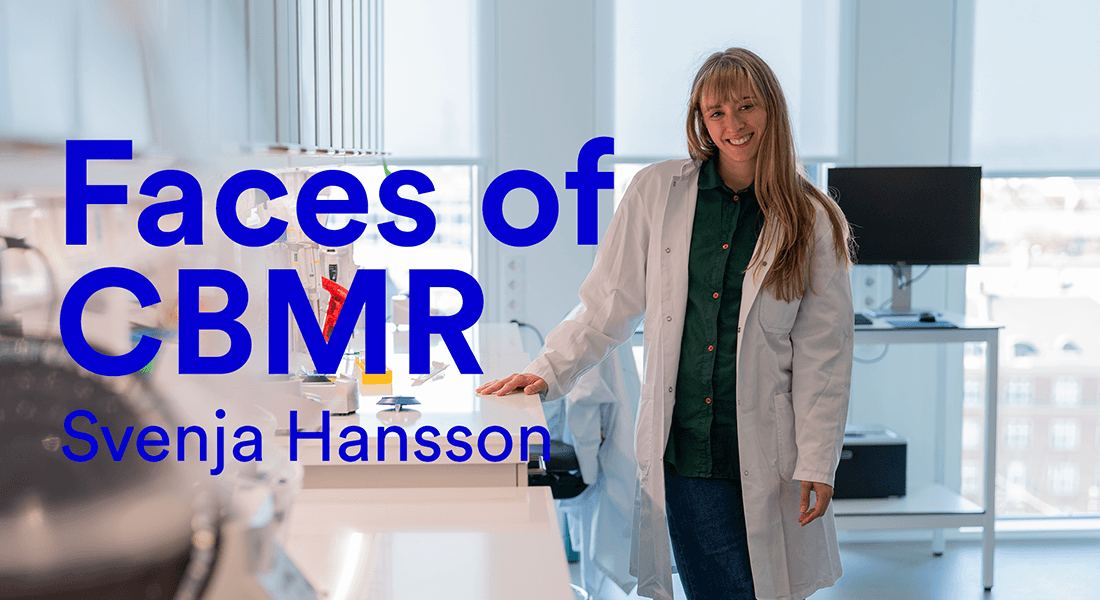
Born in Germany and raised mostly in Sweden, Svenja Hansson joined CBMR as a PhD Student in the Barrès Group, where she established a CRISPRi screening system in human stem cells differentiated into skeletal muscle to understand how exercise reshapes muscle and signals to the brain. Having recently defended her PhD, she now continues at CBMR as a Postdoc in the Pers Group, applying the same approach to neuronal cells in the context of obesity and diabetes.
In this interview, she explains why skeletal muscle has been overlooked in functional genomics, why CRISPR screens are such a powerful way to generate new hypotheses, and how a string of small, informal collaborations across CBMR helped her navigate an ambitious PhD project.
When did you develop an interest in science?
I wish I could say I had a rebellious streak, but no. Biology came naturally. My father who moved from medicine into research and a mother who is a neuroscientist. They would take me to the lab on weekends when they didn't have a babysitter, and I'd be fascinated by everything. I just loved science and thought it was cool.
What was your PhD on?
I established a CRISPRi system in human induced pluripotent stem cells (hiPSCs) and differentiated them toward skeletal muscle, then ran a high-throughput CRISPRi screen to identify targets. We wanted to understand the genome regulation behind how exercise changes skeletal muscle, and how that might act downstream on the brain, with muscle secreting factors that affect it. We had a lot of potential targets, and the screen let us go after all of them at once.
What's novel about it?
Skeletal muscle has been relatively underexplored in functional genomics. I haven't seen CRISPRi systems set up for high-throughput screens in a human skeletal muscle model . Most work there is knockout or gene-editing studies, especially for muscular dystrophies, not screening. And we didn't target genes, we targeted enhancers, the gene regulators, which isn't easily done. . We were the first to show this kind of screen is possible in skeletal muscle.
What does it tell us about human biology?
It's a basic study, so the next step is validating the candidates in vivo. What it does is narrow things down. We had many candidates and could filter to the most exciting enhancer–gene links we think drive this exercise-induced muscle-to-brain communicaion. CRISPR screens like this are really a hypothesis-generating approach: we went in unbiased, without a favorite target, and let the screen surface them. Now it comes down to building in vivo models, like a mouse model, to test whether the effect is real.
What’s the goal of the Postdoc project?
I now get to apply the same method in neuronal cells. In my PhD I studied the muscle side of the muscle–brain crosstalk and now I'm focusing on the brain, so it feels like a natural transition. The focus is gene regulation in neuronal cells in the context of obesity and diabetes. The core questions are the same as in my PhD: how gene-regulatory networks influences organ-crosstalk. The hard part is prioritization. Once you have your targets, you decide which to pursue based on whether they're supported by other literature, secreted, or exercise-regulated. Then it's about picking your favorites.
The biggest challenge of your PhD?
What I had to learn fast was to reach out to others for help. That's where CBMR is great: I'd join Emanuelli Group meetings to learn about their CRISPR work, talk to Deshmukh group about skeletal muscle, and once I realized the Pers Group wanted to pursue this type of CRISPR screen too, I joined their meetings. I gathered small pieces from experts in each area and puzzled it together.
What are some memorable moments from your time at CBMR?
I'd differentiated my CRISPRi cells toward skeletal muscle and was looking at them under the miscroscope when Postdoc Scott Frendo-Cumbo from the Zierath Group came in. As we looked at the cells we realised that the cells were spontaneously contracting, which I'd never seen before. Differentiating human skeletal muscle from iPSCs is not easy and often the differentiation is unsuccessful. Contraction is a great sign the cells have differentiated successfully, and I couldn't quite believe it, so I needed Scott standing next to me confirming: no, they really are contracting.
That was a big ‘woohoo!’ You work on optimising a protocol for so long, and don’t know if it'll work, and if it doesn't, you can lose weeks and have to problem-solve further. At this moment, I realized that I found the perfect recipe to differentiate the cells and that was such a big relief.
What motivates you, the fundamental science or the human application?
Both. When I started out I was excited about so many things, and I still am. One chapter just led to the next, with some CRISPR experience here and some metabolism there, and it all merged in my PhD, and now I've ended up in the Pers Group. I never set out with an exact plan. I love understanding something fundamental that can later feed into translational research, like therapeutics. That combination is exciting.