
“Every single person here is an expert, bringing something I hadn't thought of before”
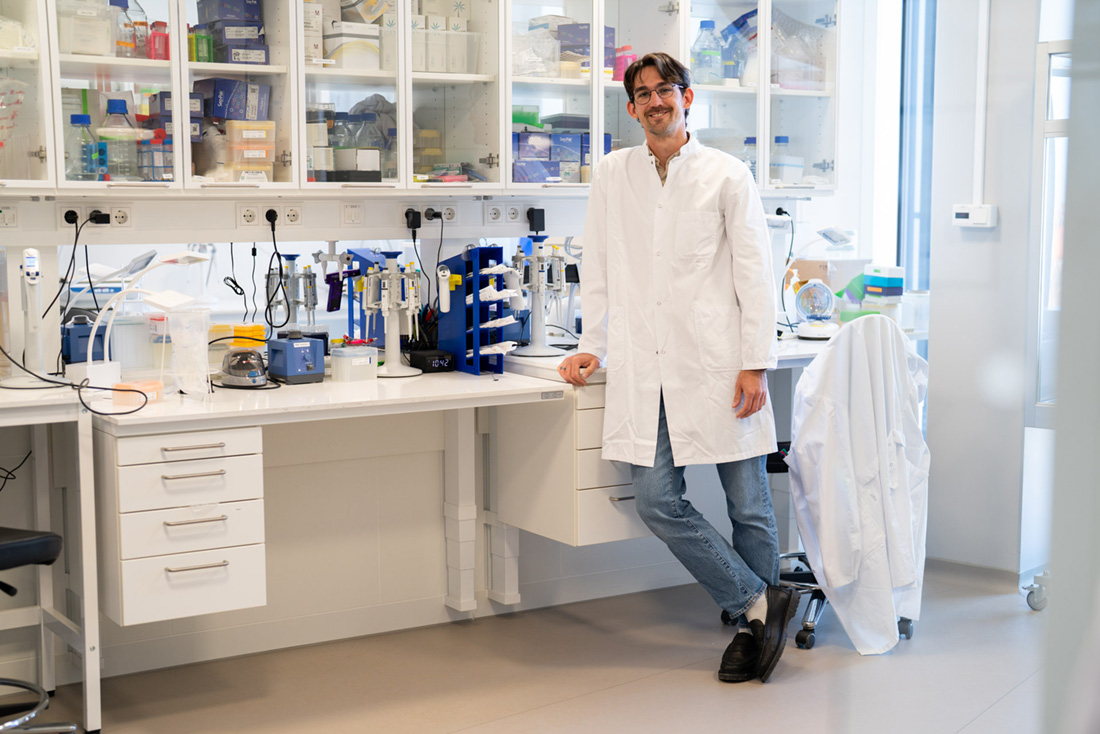
During his PhD in Canada on secreted proteins and how they influence different tissues, Postdoc Nigel Kurgan was inspired by the science coming out of Copenhagen. Scientists like Bente Pedersen and Matthias Mann were pushing the field forward, and he wanted to get as close as possible to the action. He eventually landed a position in CBMR's Deshmukh Group, led by Atul Deshmukh, and has since secured a prestigious BRIDGE Postdoctoral Fellowship. In this interview, he explains why muscle-secreted proteins are gaining attention as drivers of whole-body metabolism and how small, informal collaborations across CBMR have repeatedly saved time and shaped his research direction.
Why are secreted proteins from muscle such an interesting field to study?
We've known for a while that hormones can influence metabolism throughout the body, but those are typically produced by classical endocrine organs, like the pancreas or the gut. What's become clear more recently is that muscle does something similar, it secretes proteins that appear to act on other tissues and shape whole-body metabolism, not just locally. As we age or change our diet, the expression of these proteins can become dysregulated, and that may well feed into disease development or risk.
But the evidence is still accumulating, and we need a lot more work to prove it. Plasma is a mixture of proteins that are secreted from organs across the body, so untangling which proteins come from muscle specifically, versus fat, liver, or elsewhere, can help understand health and disease states. That's essentially where my project started in the Deshmukh Group, using bioinformatic approaches to trace circulating proteins back to their tissue of origin, and to identify which of them are regulated by acute exercise.
How did that project go?
We found more than 3,000 proteins that have different trajectories across the human body following acute exercise. This is a tremendous resource, but where do you even start with all that data?
This pushed me toward a more translational and multi-dimensional approach, which can be accomplished quite easily here at CBMR. Every single person here is an expert, bringing a skillset or a perspective i might not have had before. For example, I collaborated with Virginia Diez and Roelof Smit from the Loos Group, who taught me a lot about integrating large-scale genetic evidence, techniques like genetic co-localisation and Mendelian randomisation, which let you link changes in protein exposure to a trait outcome.
In this project we tried a triangulation approach: start with a protein that changes with exercise, check whether there's a genetic signal linking its expression to a trait, and if both line up, you have a stronger case that the protein is mechanistically tying exercise to that health outcome. I think this has been extremely effective at narrowing down this large-scale resource to what might be the most important findings.
Now on to your Bridge Fellowship. What's the project, and what inspired you?
The project is centred on gestational diabetes mellitus (GDM) and how it impacts both the mother and the child. It came through a collaboration with my clinical mentor, Allan Vaag, whose whole research career is positioned on the low-birth-weight phenotype and exposure to hyperglycaemia during pregnancy. Atul and I are very interested in secreted factors, so we wanted to apply the proteomic workflows we've developed here to this area.
Is there a personalisation angle?
I’d say it’s central to the project. Genetics is a great way to define the disease risk profile you were born into. But proteins are a product of your genetic code and are also highly influenced by your environment and lifestyle. Tracking thousands of proteins in an individual's circulation can better define personalized health and disease trajectories. I think that makes proteins an effective translational tool in the clinic to inform decision-making and long-term monitoring. That's something we're attempting to leverage in the context of low birth weight and GDM.
Tell me more about the collaborations you have struck in our Center.
That's my favourite part of working here, to be honest, getting to learn from all these super smart people. For example, I collaborate a lot with Justus, a PhD student in Simon Rasmussen's group. He's passionate about plasma proteomics and these variant-to-function approaches. He has helped on two papers we have in submission where he has led the prediction modelling.
There are so many things I've learned from people where it hasn't led to a project, but maybe it's inspired the next thing. I also do a lot of collaborations with the Clemmensen Group, primarily plasma proteomics on their mouse and rat models given different drug combinations for weight loss. Seeing how they structure their manuscripts and tackle their research questions is so different from what we do and have given me inspiration.
I still feel guilty about pulling people into my projects, you only have so much time here. But being a smaller part of someone else's project has been valuable to me. I've learned approaches in a small contribution that I can later run at scale in my own research.
It sounds like you're picking up little pieces of information from many different interactions. A little bit of information can go a long way?
Definitely. I frequently speak to Arnor or Marc from the Rasmussen group about machine learning frameworks I want to try in my research. It's something they're experts with and think about all the time. These people are just around the corner, and you learn so much in a few minutes, which can save you days of troubleshooting.
What direction are you thinking for the next step?
I really like applying proteomics to understand health and disease trajectories and applying it specifically to GDM in larger and more diverse populations is where I want to go next. It's an area that needs more work, both in improving clinical decision-making and in understanding why different people develop it. There are a few hormones people suspect are driving GDM development, but there's so much we still need to learn.