
Award
2 March 2026
Fat can be harder to lose the more we weigh – new research suggests why
Research
A team of scientists at the University of Copenhagen identified a new receptor that stops fat tissue from burning energy. The new study – which leveraged cutting-edge technologies to study 16-year-old tissue samples – opens the door for new therapies that can harness the power of diet and exercise to help fat tissue restore a healthy metabolism
The body’s fat tissue plays many important roles in our health. It safely stores and releases energy and sends and receives signaling hormones that help regulate appetite. In people with obesity or diabetes, their fat – or adipose – tissue stops functioning properly, leading to a range of negative health impacts. That is why scientists are studying adipose tissue to find new ways to prevent and treat diseases like obesity and diabetes.
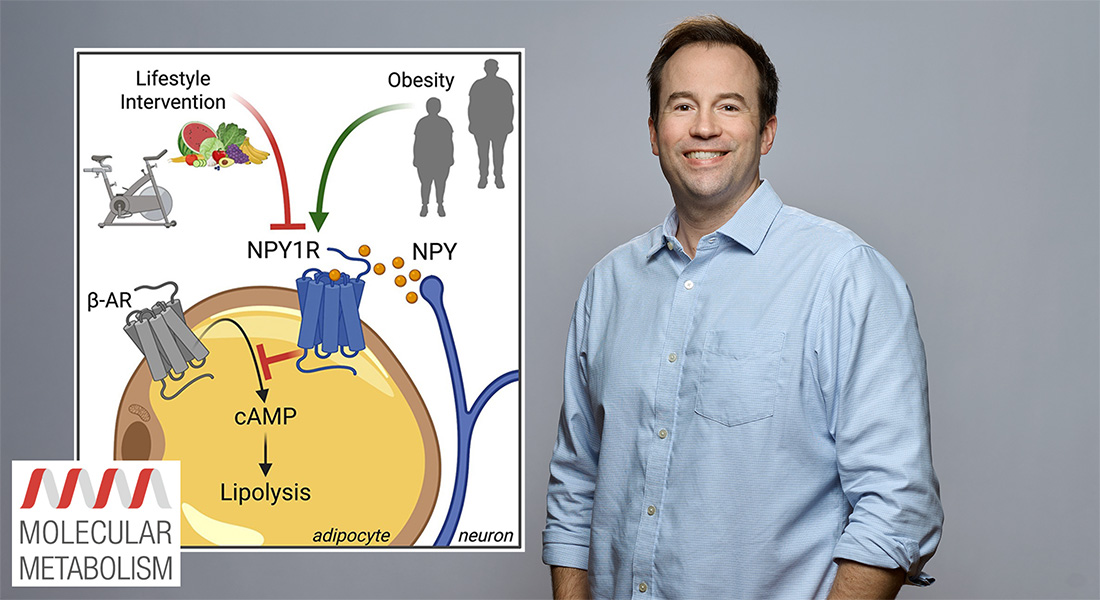
Now, a team of international scientists has discovered a receptor in fat cells called NPY1R, which acts as a molecular brake on fat burning. They found that NPY1R levels increased as people gained weight, potentially reducing the ability of adipose tissue to burn fat to meet the body’s energy needs. However, they also found that levels of NPY1R decreased as people lost weight through diet and exercise, effectively lifting the brake to potentially restore the ability of adipose tissue to release stored fat as energy.
“This study sheds new light on the positive impact that diet and exercise have on the functioning of adipose tissue. What is so promising about this study is that if we could develop a drug that switches off the brake on fat burning, through a receptor like NPY1R, we might be able to mimic the power of diet and exercise to improve overall health,” says Julius Grothen from the NNF Center for Basic Metabolic Research at the University of Copenhagen and Novo Nordisk A/S, and first author of the study in Molecular Metabolism.
New discovery from old samples
The scientists made their discovery by studying adipose tissue collected before and after a 15-week weight loss program in five men and five women. Participants were provided a diet and carried out 2-3 hours of moderate-intensity exercise five times a week.
The tissue was originally collected for a separate study conducted at the University of Copenhagen in 2006, which was subsequently frozen in a biobank. The scientists returned to these samples as new technologies now allow them to detect changes that were not possible at the time. In this case, the scientists used a technique called single-cell transcriptomics to investigate how individual cells responded to the intervention.
Their key finding was that the NPY1R receptor was far more prevalent in adipose tissue prior to the intervention than after. The scientists then identified how the receptor responds to signals released by nerves to block fat burning in adipose tissue. This pathway, previously unappreciated in fat cells, helps scientists better understand the complex signaling that shapes adipose tissue function. And how fat can be harder to lose, the more we weigh.
“There are good evolutionary reasons why adipose tissue may want to limit its ability to burn fat. The body doesn’t want more fat to circulate in the bloodstream than it can burn as energy. That’s probably why levels of this receptor, which blocks fat burning, increase as people gain weight, and decrease with weight loss, as energy demands increase due to a diet or increased exercise,” explains Associate Professor Zach Gerhart-Hines from CBMR and co-corresponding author of the study.
This study was a collaboration with Novo Nordisk A/S and the Karolinska Institutet.
Find the article ‘Single cell transcriptomics of human weight loss links adipocyte NPY1R to control of lipolysis’ in Molecular Metabolism here.
Contact
Contact
Associate Professor Zach Gerhart-Hines
University of Copenhagen
zpg@sund.ku.dk
PhD Student Julius Grothen
University of Copenhagen, Novo Nordisk A/S
julius.grothen@sund.ku.dk